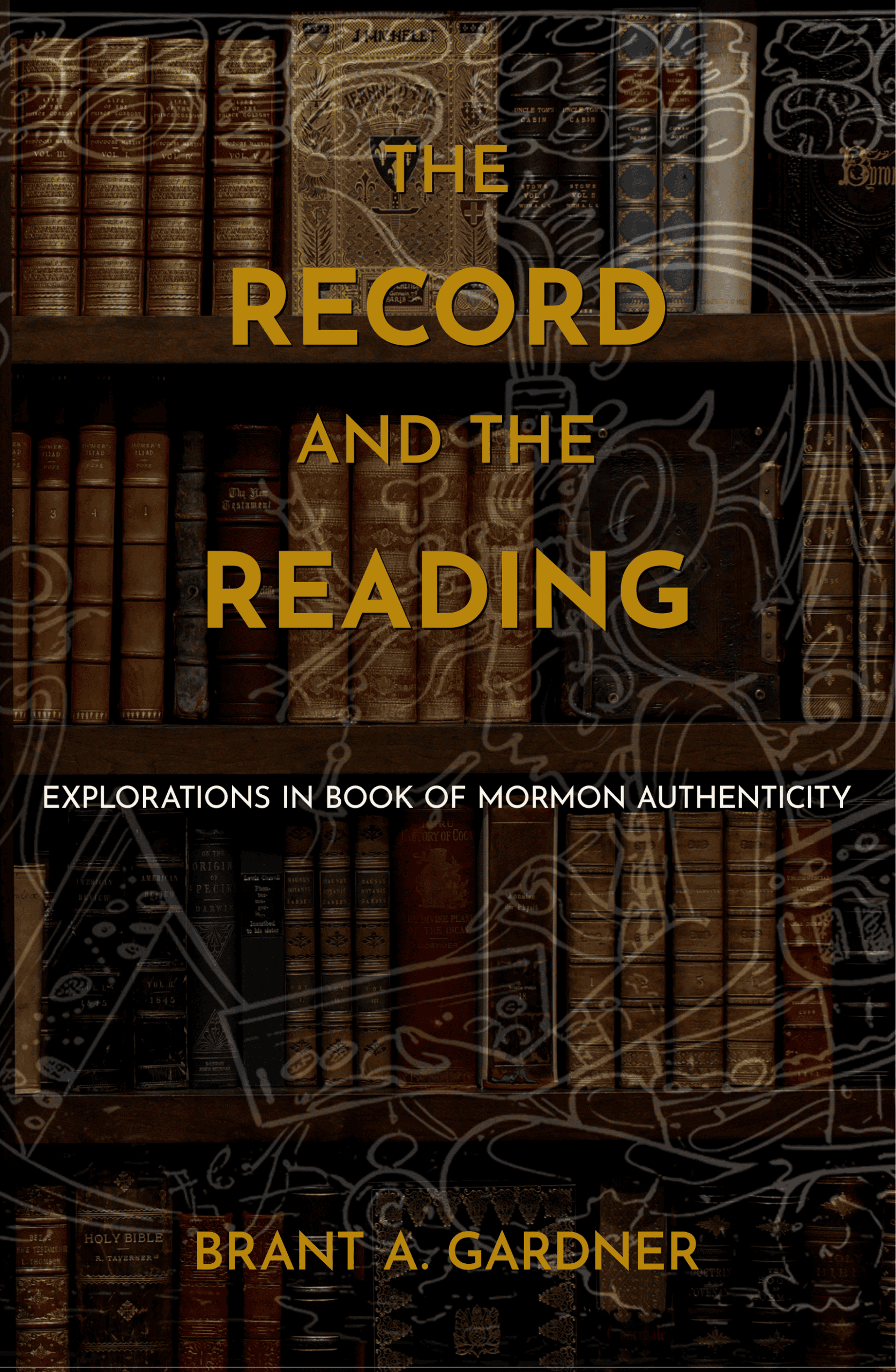
The Record and the Reading: Explorations in Book of Mormon Authenticity

Over the course of his career, Brant A. Gardner has continually refined how we read and understand the Book of Mormon. Bringing together and updating some of his classic articles and presentations from over the past twenty-five years, this volume demonstrates his methodical approach to the scripture. Addressing topics from the social history of the early Nephites to the cognitive realities of Joseph Smith’s translation process, this collection avoids easy answers and overstatement. Instead, it offers a rigorous, text-first exploration for readers looking to deepen their understanding of the Book of Mormon’s ancient setting and modern emergence.

Order on Kindle: https://www.amazon.com/dp/B0GX3131LX

A one-page sell sheet advertising this book and providing fulfillment instructions for libraries and vendors can be found here.

Reviews and Featured Articles

“Beyond the Sandy Foundation”: A Conversation with Brant A. Gardner on Book of Mormon Authenticity by Jared Riddick – FAIR Blog about this book with the author over on the FAIR Blog.

Praise for The Record and the Reading

“Brant Gardner has been a major figure in Book of Mormon studies for the last two decades, and this volume demonstrates why. These essays show Gardner at his best, a close reader who again and again mines the Book of Mormon text and excavates profound insight after profound insight. Readers who spend time with this volume will come away with a deeper sense of the world behind the Book of Mormon, a world inhabited by actual Nephites and Lamanites whose stories and experiences Gardner consistently brings to light. Through exploring the contexts (both ancient and modern) of this penetrating record, Gardner ultimately provides his witness to the authenticity of the Book of Mormon.”

Nick Frederick – Professor of Ancient Scripture, Brigham Young University

“By the time Terryl Givens published his By the Hand of Mormon in 2003, the project of studying the Book of Mormon primarily in conversation with the ancient near east had slowed significantly. In 2010, Grant Hardy’s Understanding the Book of Mormon announced an era of Book of Mormon research that has proven to be especially focused on literary analysis and theological interpretation. The man who carried the torch for Book of Mormon Studies between these two eras was Brant Gardner. With one eye looking backward to the best of historicizing study, and with the other looking forward to literary analysis of the Book of Mormon’s shape, Gardner built the bridge between the twentieth and twenty-first centuries of Book of Mormon research. Readers of this wonderful collection of Gardner’s ‘greatest hits’ will walk the length of that bridge and take in some remarkable views.”

Joseph M. Spencer, Associate Professor of Ancient Scripture at Brigham Young University

Engraven Upon Plates, Printed Upon Paper: Textual and Narrative Structures of the Book of Mormon

  • “There is no more intelligent or systematic analysis of the Book of Mormon’s composition, translation, structure, themes, and purposes than Brant Gardner’s Engraven Upon Plates, Printed Upon Paper.” — Don Bradley
  • “This expansive study immediately rises to the top of must-read resources relative to the Book of Mormon.” — Kerry Hull
  • “Any reader seeking a deeper insight into construction and realization of the Book of Mormon text will find much to admire in this project.” — Nicholas J. Frederick
  • “No one person has made a more thorough attempt to account for all the historical dimensions of the Book of Mormon.” — Joseph M. Spencer
  • “Yields an array of insights into the Book of Mormon as we have it today. . . . Every one interested in the origins, composition, and purpose of the text should carefully consider each of the textual layers Garder has identified.” — Neal Rappleye

Traditions of the Fathers: The Book of Mormon as History

Traditions of the Fathers: The Book of Mormon as History

Brant A. Gardner.  Salt Lake City, Utah:  Greg Kofford Books, 2015.

The focus of the Book of Mormon is unquestionably on the things of God. Similar to the Bible, its sermons and explications of religious principles are presented against the framework of the story of a people. It is a story that covers a thousand years. In this book Brant Gardner looks around and behind the religious purposes of the book and teases out how those thousand years of Book of Mormon history correspond to those same years in the geographic and cultural context where they most plausibly took place.

Gardner works through the Book of Mormon chronologically, examining how events in the Book of Mormon reflect the greater historical and cultural developments happening around them at the same time. Gardner asks and answers questions against particular historical backdrops. Why does Nephi appear to be so Christian so long before Christ, and why does his particular time period in Jerusalem help answer that question? Why do Nephi apostate groups from different times appear to adopt the same religion? Why does the Book of Mormon end around A.D. 400? Why not earlier or later? The answers are developed by looking at the Book of Mormon as history in the context of what has become known of Mesoamerican history. Along the way, Gardner also looks at the problem of anachronisms, DNA, and some popular “proofs” of the Book of Mormon that need to be abandoned.

Gift and Power, The: Translating the Book of Mormon

Gift and Power, The: Translating the Book of Mormon

http://www.ldschurchnews.com/articles/61249/By-the-gift-and-power-of-God.html

Brant A. Gardner.  Salt Lake City, Utah:  Greg Kofford Books, 2011.  Hardbound, 6.25×9.25″, 391 pages.

The Book of Mormon was presented to the world as the translation of an ancient text engraved on golden plates more than 180 years ago. However, the faithful assurance that it is a translation has not had an accompanying understanding of how that translation took place. How could the ill-educated Joseph Smith translate the ancient text on the golden plates into the English Book of Mormon upon which so many base not only their faith, but a willingness to completely change their lives?

The Gift and Power: Translating the Book of Mormonexamines the various issues surrounding that translation. How does the fact of the translation fit into a magical worldview in which Joseph had a place as a village seer? What might that context mean for our understanding of the text?

This work explores the kind of translation the Book of Mormon represents. Did Joseph Smith or the marvelous instruments do the actual work of translation? Is it a tight or loose translation? How closely tied is the English text to the source text from which it was translated? What about Hebraisms in the text? What about the lengthy passages of King James English in it?

The volume concludes with the most puzzling and persistent questions: How did the seer stones work? Why didn’t Joseph retranslate the Book of Lehi? How did revival language make its appearance in the book? Why couldn’t Oliver Cowdery translate? Brant Gardner offers answers to these questions. The result is a faithful description of how God used a human prophet to translate a transcendentally important scriptural text.

The Plates of Mormon: A Book of Mormon Study Edition Based on Textual and Narrative Structures in the English Translation

  • “Encountering the Book of Mormon’s text arranged according to its own internal clues is like listening to Mormon reading it aloud to us across the millennia. . . . This is the study edition I will be using.” — Don Bradley
  • “Readers will engage anew with the text of the Book of Mormon in this logically and creatively reformatted presentation, supported by highly insightful footnotes. There is much to be gained from this innovative contribution to Book of Mormon studies.” — Kerry Hull
  • “Highly recommended to any and all readers who want to more deeply engage the text of the Book of Mormon. . . . A remarkable achievement.” — Nicholas J. Frederick
  • “Provides a new and enjoyable experience, one which rewards its readers with new insights as the familiar chapter-and-verse structure is shaken up.” — Jared Riddick

A Documentary History of the Book of Mormon

Compiled by Larry E. Morris

The story of the creation of the Book of Mormon has been told many times, and often ridiculed. A Documentary History of the Book of Mormon presents and examines the primary sources surrounding the origin of the foundational text of the Church of Jesus Christ of Latter-day Saints, the most successful new religion of modern times.

The scores of documents transcribed and annotated in this book include family histories, journal entries, letters, affidavits, reminiscences, interviews, newspaper articles, and book extracts, as well as revelations dictated in the name of God. From these texts emerges the captivating story of what happened (and what was believed or rumored to have happened) between September 1823-when the seventeen-year-old farm boy Joseph Smith announced that an angel of God had directed him to an ancient book inscribed on gold plates-and March 1830, when the Book of Mormon was first published. By compiling for the first time a substantial collection of both first- and secondhand accounts relevant to the inception of the divine revelation-or clever fraud-that launched a new world religion, A Documentary History makes a significant contribution to the rapidly growing field of Mormon Studies.

Larry E. Morris, formerly an editor with the Joseph Smith Papers, is the author of The Fate of the Corps: What Became of the Lewis and Clark Explorers after the Expedition. Morris has published articles in such periodicals as The Missouri Historical Review, American History, the Journal of Mormon History, BYU Studies, and We Proceeded On.

“No other source contains in one volume such a comprehensive view of all the relevant documents to the coming forth of the Book of Mormon. Larry E. Morris has provided an invaluable resource for researchers and interested parties.” — Cheryl L. Bruno, Association for Mormon Letters

“Larry Morris brings together for the first time in one volume the essential documents for understanding the Book of Mormon’s origins. With abundant documentation and insightful commentary, Morris chronicles each scene of the book’s history—from Moroni’s first visit through the book’s 1830 publication, allowing the historical players to speak for themselves. While giving priority to sources closest in time and place to the events described, Morris brings together the voices of true believers and avowed skeptics, immersing readers in the drama and controversy of what is likely the most important literary work in American history. Scholars and laypersons alike will find the volume indispensable.” –Boyd Petersen, Program Coordinator for Mormon Studies, Utah Valley University

“Larry Morris’s book is the essential bedrock upon which future studies of the Book of Mormon will be based. Whether mined for understanding the believer’s viewpoint or its reception among the wider population, these are documents that matter. Morris has collected the essentials for both novice and specialist alike. The carefully edited and introduced collection provides a rich and rounded view of this important topic in American history.”–Brant A. Gardner, author of Second Witness: Analytical and Contextual Commentary on the Book of Mormon

“This book is indispensable for anyone, scholar or interested amateur, who wants to know and understand the documents related to Joseph Smith’s assertion that he found gold plates and translated them by the power of God into the Book of Mormon. Smith’s claims launched a radical religious movement that has had a major impact on American history and Morris has collected here, with impressive detail, the records essential to understanding its origins.” –Gerrit Dirkmaat, Assistant Professor of Church History and Doctrine, Brigham Young University

One: “He Appeared unto Me Three Times in One Night”
Joseph and the Angel: September 1823-September 1826

Two: “The Same Heavenly Messenger Delivered Them Up To Me”
Joseph and the Plates: September-December 1827

Three: “I Cannot Read a Sealed Book”
Martin Harris’s Venture to Eastern Scholars: February 1828

Four: “I Stood Alone, an Unlearned Youth”
The Translation Begins: April-June 1828

Five: “I Have Lost My Soul”
Martin Harris and the Missing Manuscript: Summer 1828

Six: “It Is Marvelous to Me”
Interlude: Autumn 1828-March 1829

Seven: “Days Never To Be Forgotten”
The Translation: April-May 1829

Eight: “I Often Sat By and Saw and Heard Them Translate and Write for Hours Together”
The Translation: June 1829

Nine: “An Angel of God Came Down from Heaven”
The Three Witnesses: Late June 1829

Ten: “The Appearance of Ancient Work, and of Curious Workmanship”
The Eight Witnesses: Late June 1829

Eleven: “Written by the Hand of Mormon”
Publication of the Book of Mormon: June 1829-March 1830

Second Witness: Analytical & Contextual Commentary on the Book of Mormon 6 Vol. Set

Second Witness: Analytical & Contextual Commentary on the Book of Mormon Vol 1 First Nephi

Brant A. Gardner, Salt Lake City: Greg Kofford Books, 2007, 7.25×10.25″ hardbound, 6 Volume Set.  Vol. 1, 512 pages; Vol. 2, 652 pages; Vol. 3, 570 pages; Vol. 4, 872; Vol. 5, 670 pages; Vol. 6, 698 pages.

Commentaries on scriptural texts attempt to deepen the experience of the reader with the text they are reading. Different commentaries take very different approaches to the same text. There is so much that may be said about the Book of Mormon that no single commentary can hope to be exhaustive. In this commentary, the attempt is to bring to bear the insights of multiple disciplines and multiple scholars into a single location where the concentration of information at the point of the text may assist us in understanding a particular passage, and from the individual passages, the greater message of this most marvelous book.

The commentary is laid out with the comments interwoven with the text of the Book of Mormon. In all cases, the intermixing of scripture and commentary is intended to focus attention on the text itself. Even with such a focus on specific texts, there is an overall view of the real people and their times that develop through the text. This cultural background becomes more and more important as the scriptural text moves from the somewhat familiar Old World and into the more exotic New World.

Second Witness: Analytical & Contextual Commentary on the Book of Mormon Vol 6 4th Nephi to Moroni

Second Witness: Analytical & Contextual Commentary on the Book of Mormon Vol 6 4th Nephi to Moroni

Brant A. Gardner, Salt Lake City: Greg Kofford Books, 2008, 7.25×10.25″ hardbound, 698 pages.

Commentaries on scriptural texts attempt to deepen the experience of the reader with the text they are reading. Different commentaries take very different approaches to the same text. There is so much that may be said about the Book of Mormon that no single commentary can hope to be exhaustive. In this commentary, the attempt is to bring to bear the insights of multiple disciplines and multiple scholars into a single location where the concentration of information at the point of the text may assist us in understanding a particular passage, and from the individual passages, the greater message of this most marvelous book.

The commentary is laid out with the comments interwoven with the text of the Book of Mormon. In all cases, the intermixing of scripture and commentary is intended to focus attention on the text itself. Even with such a focus on specific texts, there is an overall view of the real people and their times that develop through the text. This cultural background becomes more and more important as the scriptural text moves from the somewhat familiar Old World and into the more exotic New World.

Second Witness: Analytical & Contextual Commentary on the Book of Mormon Vol 5 Helaman – Third Nephi

Second Witness: Analytical & Contextual Commentary on the Book of Mormon Vol 5 Helaman - Third Nephi

Brant A. Gardner, Salt Lake City: Greg Kofford Books, 2007, 7.25×10.25″ hardbound, 670 pages.

Commentaries on scriptural texts attempt to deepen the experience of the reader with the text they are reading. Different commentaries take very different approaches to the same text. There is so much that may be said about the Book of Mormon that no single commentary can hope to be exhaustive. In this commentary, the attempt is to bring to bear the insights of multiple disciplines and multiple scholars into a single location where the concentration of information at the point of the text may assist us in understanding a particular passage, and from the individual passages, the greater message of this most marvelous book.

The commentary is laid out with the comments interwoven with the text of the Book of Mormon. In all cases, the intermixing of scripture and commentary is intended to focus attention on the text itself. Even with such a focus on specific texts, there is an overall view of the real people and their times that develop through the text. This cultural background becomes more and more important as the scriptural text moves from the somewhat familiar Old World and into the more exotic New World.

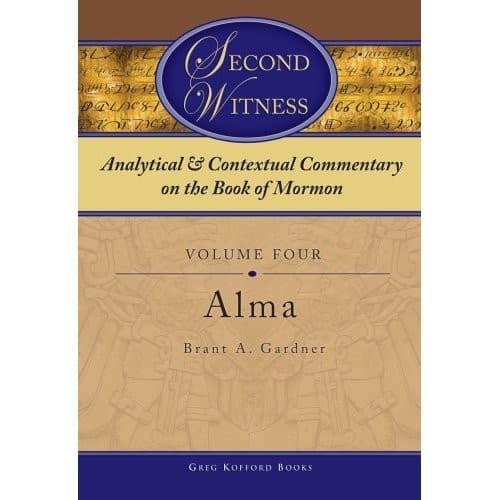
Second Witness: Analytical & Contextual Commentary on the Book of Mormon Vol 4 Alma

Second Witness: Analytical & Contextual Commentary on the Book of Mormon Vol 4 Alma

Brant A. Gardner, Salt Lake City: Greg Kofford Books, 2007, 7.25×10.25″ hardbound, 872 pages.

Commentaries on scriptural texts attempt to deepen the experience of the reader with the text they are reading. Different commentaries take very different approaches to the same text. There is so much that may be said about the Book of Mormon that no single commentary can hope to be exhaustive. In this commentary, the attempt is to bring to bear the insights of multiple disciplines and multiple scholars into a single location where the concentration of information at the point of the text may assist us in understanding a particular passage, and from the individual passages, the greater message of this most marvelous book.

The commentary is laid out with the comments interwoven with the text of the Book of Mormon. In all cases, the intermixing of scripture and commentary is intended to focus attention on the text itself. Even with such a focus on specific texts, there is an overall view of the real people and their times that develop through the text. This cultural background becomes more and more important as the scriptural text moves from the somewhat familiar Old World and into the more exotic New World.