• Skip to primary navigation
  • Skip to main content
  • Skip to primary sidebar
  • Skip to footer

FAIR

  • Find Answers
  • Blog
  • Media & Apps
  • Conference
  • Bookstore
  • Archive
  • About
  • Get Involved
  • Search

Blog

Faith and Reason 65: Heliocentric Universe

March 5, 2016 by FAIR Staff

https://media.blubrry.com/mormonfaircast/www.fairlatterdaysaints.org/wp-content/uploads/2016/02/Heliocentric-Universe-1.mp3

Podcast: Download (6.1MB)

Subscribe: RSS


From the book: Of Faith and Reason: 80 Evidences Supporting the Prophet Joseph Smith

By Michael R. Ash

According to the Book of Abraham, the highest celestial objects “govern” the objects below them (see Abraham 3:3, and Facimile 2, fig. 5). Likewise, when we turn to the Apocalypse of Abraham, we find that God’s throne is in the highest of heavens and that His commands are passed down by angels through the various levels of heaven. Each of the higher levels governs and commands the lower levels. While such a cosmology makes little sense from the heliocentric cosmology of Joseph Smith’s milieu, it makes perfect sense from the ancient cosmologies accepted by the ancient people of the Near East.

Michael R. Ash is the author of: Of Faith and Reason: 80 Evidences Supporting The Prophet Joseph Smith. He is the owner and operator of MormonFortress.com and is on the management team for FairMormon. He has been published in Sunstone, Dialogue: A Journal of Mormon Thought, the Maxwell Institute’s FARMS Review, and is the author of Shaken Faith Syndrome: Strengthening One’s Testimony in the Face of Criticism and Doubt. He and his wife live in Ogden, Utah, and have three daughters.

Julianne Dehlin Hatton has worked as a News Director at an NPR affiliate, Television Host, News Anchor, and Airborne Traffic Reporter. She graduated with an MSSc from the Maxwell School of Citizenship and Public Affairs at Syracuse University in 2008. Julianne and her husband Thomas are the parents of four children.

Music for Faith and Reason is provided by Arthur Hatton.
Filed Under: Faith and Reason, Julianne Dehlin Hatton, Podcast Tagged With: Faith and Reason, Julianne Dehlin Hatton, Michael R. Ash

Lehi’s Lasting Legacy

February 29, 2016 by Neal Rappleye

Tree

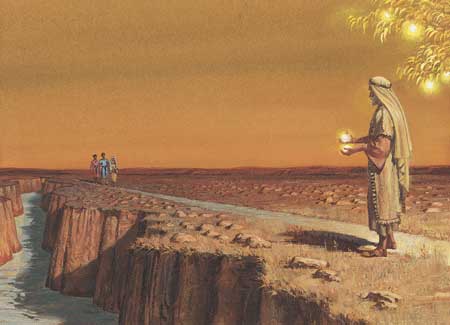
Nephi tells us that his father, Lehi, kept a record (1 Nephi 1:17). That record is lost to history, but nonetheless his legacy lives on. His son recorded a number of his most profound prophecies and visions. These include his prophetic call vision, powerful poetic declarations to his two oldest sons while encamped in an Arabian wadi, his moving dream about the tree of life, and his prophecies about the Messiah.

Lehi’s legacy was solidified by the testament he left behind. While nearing his death, Lehi called together his posterity, warned them of temptations, taught them to live righteously, blessed them, and related prophecies (2 Nephi 1–4). Book of Mormon Central has dubbed this the “Testament of Lehi” because it has all the characteristics found in the Jewish testamentary literature. Book of Mormon Central also comments on the legacy this creates for Lehi:

It provides an example for fathers and patriarchs today. The tradition, initially but briefly present in Genesis 49, was not maintained and developed only by the Jews after their return to Jerusalem in the Second Temple period but was called upon extensively and effectively by Lehi in the sixth century BC. Building from there, later prophets in the Book of Mormon followed Lehi’s example, as Alma does in Alma 36–42 and Helaman does in Helaman 5:5–13. Latter-day Saint fathers today also follow these patriarchal examples as they bless, instruct, exhort, and testify to their children and grandchildren.

Some of Lehi’s most influential teachings were given as part of his testament. For instance, drawing on the imagery of the Psalms, Lehi taught about the importance of offering the Lord your broken heart and contrite spirit. Of this teaching, Book of Mormon Central pointed out, “This presents an important lesson for modern Book of Mormon readers. No matter what sacrifice we offer to the Lord—be it our time, our talents, etc.—if this is not done with the true sacrifice of our hearts and spirits, then it cannot be fully acceptable to the Lord.”

It is also as part of his testament that Lehi gave his epic discourse on the Fall. Drawing from the hints found in the Old Testament and Israelite temple traditions, Lehi provided the most complete teaching on the Fall presently on record. According to Book of Mormon Central,

Lehi’s teaching was the foundation for several other important sermons in the Book of Mormon by Alma, Amulek, and others, and continues to be the foundation upon which we build when we teach the Fall today.

Nephi’s love for Isaiah may have come from Lehi, since Lehi appears to be drawing on Isaiah 14:12 when he describes Satan. Isaiah 14 is drawing on a rich ancient Near Eastern mythos of a fallen deity, and like he does with the Fall, Lehi expands on Isaiah’s use to provide a fuller view of the Adversary. Indeed, Lehi seems well versed in the great literature of his day and time, as he poetically describes death in a way the resonates not only with the much later Shakespeare, but also with ancient Egyptian, Mesopotamian, Canaanite, and Israelite motifs.

Drawing on both the literary form and the language of the Psalms, Nephi lamented after his father passed away. Nephi, however, was not the only one of Lehi’s sons who was profoundly impacted by their father’s influence. In his first sermon recorded in the Book of Mormon, Jacob taught many of the same doctrines Lehi had taught to him. As Book of Mormon Central puts it,

Tracing Jacob’s understanding of the plan back one generation earlier, it appears that his inspired summation carried forth the influence of his father’s instructions to him in 2 Nephi 2. Although Lehi never called it a “plan,” he taught these same doctrines in his final blessing to Jacob.

Comparing the two also illuminates which doctrines both Lehi and Jacob most related to:

Though they taught the same doctrines, Lehi’s emphasis was focused more on the fall, opposition, and the agency afforded to all to choose between good and evil. Jacob, meanwhile, put more emphasis on the atonement, resurrection, and the eternal outcome from choosing either righteousness or filthiness.

Jacob also shows an awareness of Israelite and ancient Near Eastern conceptions of death. Given that Jacob was born in the wilderness and was still very young when the family arrived in the promised land, this knowledge surely came to him through his father’s teachings.

Given the reverence both Nephi and Jacob had for Lehi, it may seem odd that Nephi summoned Isaiah to act as a third witness of the Redeemer alongside Nephi and Jacob. Lehi had already born witness of Christ, multiple times (1 Nephi 1:19; 1 Nephi 10; 2 Nephi 2). Yet, this may actually be one of the most powerful reflections of Nephi’s love for his father.

Lehi was believed to be a false prophet by both the Jews at Jerusalem and also his two oldest sons, Laman and Lemuel. The penalty for false prophecy was death, and Laman and Lemuel try to kill him multiple times. Biblical law required two or three witnesses (Deuteronomy 19:15) to testify in a trail. As such, coming on the heels of Lehi’s passing, and the division of Nephi from his brothers, 2 Nephi 6–30, recording the testimonies of Nephi’s three witnesses—Jacob, Isaiah, and Nephi—could be read as the Apology of Lehi.

That is, it is Nephi’s defense of Lehi as a true prophet, marshalling the biblically required three witnesses to verify Lehi’s own prophecies about the Messiah. This would explain why Lehi himself was not considered one of the witnesses—he was the defendant. If this is correct, then it would speak powerfully to the legacy of Lehi, as nearly all of 2 Nephi would be dedicated to him in some capacity.

In either case, there is no denying the abundant legacy of Lehi left behind by his sons.

Neal Rappleye is a Research Project Manager for Book of Mormon Central. He blogs on Latter-day Saint topics at http://www.studioetquoquefide.com/

Filed Under: Book of Mormon, LDS Scriptures Tagged With: apologetics, Book of Mormon, FairMormon, Lehi, Prophets

Fair Issues 95: A Journey across the “narrow neck”

February 28, 2016 by Ned Scarisbrick

https://media.blubrry.com/mormonfaircast/www.fairlatterdaysaints.org/wp-content/uploads/2016/02/Fair-Issue-95-Pod.mp3

Podcast: Download (18.6MB)

Subscribe: RSS

Ash (newer) PictureIn this episode brother Ash offers several explanations and illustrations for what could be considered the “narrow neck” of land in the Book of Mormon.

The full text of this article can be found at Deseret News online.

Brother Ash is author of the book Shaken Faith Syndrome: Strengthening One’s Testimony in the Face of Criticism and Doubt, as well as the book, of Faith and Reason: 80 Evidences Supporting the Prophet Joseph Smith. Both books are available for purchase online through the FairMormon Bookstore. Tell your friends about the Mormon Fair-Cast. Share a link on your Facebook page and help increase the popularity of the Mormon Fair-Cast by subscribing to this podcast in iTunes, and by rating it and writing a review.

The views and opinions expressed in the podcast may not reflect those of the Church of Jesus Christ of Latter-day Saints or that of FairMormon


Filed Under: Apologetics, Book of Mormon, Evidences, Fair Issues, General, Geography, Hosts, Michael R. Ash, Ned Scarisbrick, Podcast Tagged With: Book of Mormon Geography, narrow neck of land

Faith and Reason 64: Ur and Olishem

February 10, 2016 by FAIR Staff

https://media.blubrry.com/mormonfaircast/www.fairlatterdaysaints.org/wp-content/uploads/2016/02/Ur.mp3

Podcast: Download (7.0MB)

Subscribe: RSS

From the book: Of Faith and Reason: 80 Evidences Supporting

the Prophet Joseph Smith by Michael R. Ash

Recent scholarship suggests that Ur might have been in northern Syria and southern Turkey in a place known anciently as Aram-Naharaim (northwestern Mesopotamia in ancient times). Not coincidentally, ancient Aram-Naharaim was under the influence of Egypt during the days of Abraham. An added layer of support comes from the Book of Abraham’s mention of the Plain of Olishem, which apparently was a part of the land of Chaldea. While the bible never mentions such a place, scholars have recently discovered and inscription of the name Olishem dating to about 2250 BC in Northwestern Syria –just where we would expect to find it according to Joseph Smith.

Michael R. Ash is the author of: Of Faith and Reason: 80 Evidences Supporting The Prophet Joseph Smith. He is the owner and operator of MormonFortress.com and is on the management team for FairMormon. He has been published in Sunstone, Dialogue: A Journal of Mormon Thought, the Maxwell Institute’s FARMS Review, and is the author of Shaken Faith Syndrome: Strengthening One’s Testimony in the Face of Criticism and Doubt.  He and his wife live in Ogden, Utah, and have three daughters.

Julianne Dehlin Hatton  has worked as a News Director at an NPR affiliate, Television Host, News Anchor, and Airborne Traffic Reporter. She graduated with an MSSc from the Maxwell School of Citizenship and Public Affairs at Syracuse University in 2008. Julianne and her husband Thomas are the parents of four children.

Music for Faith and Reason is provided by Arthur Hatton.

Filed Under: Uncategorized

1 Nephi: An Arabian Testament

January 28, 2016 by Neal Rappleye

In 1844, the Prophet Joseph Smith went to his grave testifying of the Book of Mormon. By that point in his life, he had lived in the forests of Vermont and New York, the plains of Ohio and Missouri, and the swampy river bottoms of Nauvoo, Illinois. Yet the publication that defined his life began in a totally different world. The opening chapters of the Book of Mormon have a distinctly Arabian flavor, garnished with some Israelite and Egyptian dressings.

Growing up in the late-7th century BC, Nephi wrote in “the learning of the Jews and the language of the Egyptians” (1 Nephi 1:2). Critics in the 1830s scoffed at the idea of Jews writing in Egyptian, and for decades this particular phrase was difficult even for believers to understand. Now, archaeological finds have uncovered over 200 texts in Israel dating to the 8th–7th centuries BC that use Egyptian script in a distinctive way. The peculiar phrasing of 1 Nephi 1:2 proves to be an apt description of what some scholars are calling “Palestinian hieratic.”

[Read more…] about 1 Nephi: An Arabian Testament

Filed Under: Uncategorized

Book Review: “The Joseph Smith Papers: Journals: Volume 3: May 1843 – June 1844”

January 24, 2016 by Trevor Holyoak

Available from the FairMormon Bookstore at 15% off
In 1992, the second volume of Dean C. Jesse’s “The Papers of Joseph Smith” was published, containing the journal entries of 1832-1842. Many of us waited for years for the third volume, which would cover the remainder of Joseph’s life, before finally finding out that Jesse’s work was being expanded into the Joseph Smith Papers Project. Finally, with the recent release of volume 3 of the Journals series, the journals have all been published.

The volume begins with a timeline of Joseph Smith’s life, maps, an introduction that outlines the events of the last year of a very busy life, and the usual explanation of the editorial method being used for the Joseph Smith Papers Project. It then contains the text of the journals followed by three appendixes which are relevant excerpts from journals kept by Willard Richards and William Clayton detailing Joseph Smith’s activities during this time period. There is also a section of reference materials containing things like a chronology, pedigree chart, glossary, and organizational charts of the church and Nauvoo. There is a full index of all three volumes in the Journals series. (Previous volumes didn’t contain an index due to this planned combined index, but individual indexes can be found online and were provided in print on request.) There are also photos scattered throughout of things like the actual journals, the Kinderhook plates, the first issue of the Nuavoo Neighbor, a list of marriages and sealings that was added at the end of one of the journals later, and the guns in the possession of Joseph and Hyrum Smith at Carthage Jail.

[Read more…] about Book Review: “The Joseph Smith Papers: Journals: Volume 3: May 1843 – June 1844”

Filed Under: Book reviews, Joseph Smith, LDS History, Polygamy, Prophets, Temples

Book Review: “The Coming Forth of the Book of Mormon: A Marvelous Work and a Wonder”

January 19, 2016 by Trevor Holyoak

The Coming Forth of the Book of Mormon: A Marvelous Work and a Wonder
Available from the FairMormon Bookstore at 15% off
This book contains the papers from the 44th Annual Brigham Young University Sidney B. Sperry Symposium, held in October, 2015. The Sperry Symposium is held annually, and draws most of its speakers from the Church Educational System. Each year’s theme is usually based on the book of scripture that will be studied by LDS adults in the coming year, and this volume fits right in with this year’s Gospel Doctrine study of the Book of Mormon.

The first paper in the book is by Elder Merrill J. Bateman. He gave the keynote speech on “The Coming Forth of Plain and Precious Truths.” He describes many aspects of the gospel that may be only vaguely mentioned in the Bible, but for which we learn much more from the Book of Mormon. Some examples are the plan of salvation, the premortal life, the fall of Adam, the atonement and resurrection, and specific doctrines taught by Christ.

[Read more…] about Book Review: “The Coming Forth of the Book of Mormon: A Marvelous Work and a Wonder”

Filed Under: Apologetics, Book of Mormon, Book reviews, Doctrine, Evidences, Joseph Smith, LDS History, LDS Scriptures, Lesson Aids, Prophets

What did President Kimball think about pressure regarding the pre-1978 priesthood ban?

January 12, 2016 by Gregory Smith

There is a school of thought among some who believe that the united voice of the First Presidency and Quorum of the Twelve is mistaken on some point or other (e.g., gay marriage, the sinfulness of homosexual sexual acts, etc.) They then conclude that fixing this problem requires “advocacy”—i.e., public appeals, clamor, protests, or public arguments in favor of altering policy or doctrine. Or, they insist that we need to publicly discuss what “should be done” in these matters, and that such activity is both proper and helpful. (They even, as I discussed yesterday, sometimes claim that God has told them by revelation that the apostles are mistaken, and that God sanctions their public disagreement and advocacy.)

Those who make this argument generally appeal to the change made with the reversal of the pre-1978 priesthood ban. They believe that such behavior was appropriate then, and that it helped President Kimball seek and receive the revelation of 1978.

I think, however, that this fundamentally misunderstands both the history of the priesthood ban and how Church government works. I say this partly out of conviction of how such things are said to work in theory, and partly out of observation for how I’ve seen them work in practice.

President Kimball: the clear expert

But, to me the most compelling argument for that position is what President Kimball himself said about it. If anyone is situated to tell us what would promote or trigger that kind of revelation in these instances, I take it to be him.

What were his views on those who sought to push the matter through advocacy, public dialogue, or such tactics? Were these efforts helpful? Proper?

He did not think so.

[Read more…] about What did President Kimball think about pressure regarding the pre-1978 priesthood ban?

Filed Under: Uncategorized

“What Should I Do If I Think I’ve Received Revelation Different from Apostles and Prophets?”

January 11, 2016 by Gregory Smith

What ought we to do if we believe we have received revelation that differs with the united voice of the First Presidency and Twelve apostles?

One of the great strengths–and arguably one of the defining features–of LDS doctrine as a belief in on-going revelation, both to Church leaders and individuals members. Members understand that the revelation they receive is only for their areas of stewardship and responsibility.

What should we do, then, in the case where we sincerely believe we have received revelation that tells us that the highest councils of united Church leaders are mistaken?

I here suggest five important principles drawn from apostles and prophets about such situations, which have blessed my life.
[Read more…] about “What Should I Do If I Think I’ve Received Revelation Different from Apostles and Prophets?”

Filed Under: Doctrine, Faith Crisis, General Conference, Power of Testimony, Prophets

Faith and Reason 63: Four Hundred Year Baktun

January 9, 2016 by FAIR Staff

https://media.blubrry.com/mormonfaircast/www.fairlatterdaysaints.org/wp-content/uploads/2016/01/400-Year-Bactun.mp3

Podcast: Download (5.9MB)

Subscribe: RSS


From the book: Of Faith and Reason: 80 Evidences Supporting the Prophet Joseph Smith

by Michael R. Ash

The time obsessed Maya measured time by a four hundred year interval known as a baktun. The baktun was made up of the extremely important twenty year sub-interval known as the katun. Not only do we find the four hundred year baktun in the Book of Mormon, but Moroni bids us farewell “Four hundred and twenty years” –or one katun after the final baktun following the sign that was given of the coming of Jesus Christ.

“Bamboozled by the CES Letter” can be found here:

http://www.shakenfaithsyndrome.com/bamboozle/bamboozled.pdf

Michael R. Ash is the author of: Of Faith and Reason: 80 Evidences Supporting The Prophet Joseph Smith. He is the owner and operator of MormonFortress.com and is on the management team for FairMormon. He has been published in Sunstone, Dialogue: A Journal of Mormon Thought, the Maxwell Institute’s FARMS Review, and is the author of Shaken Faith Syndrome: Strengthening One’s Testimony in the Face of Criticism and Doubt.  He and his wife live in Ogden, Utah, and have three daughters.

Julianne Dehlin Hatton  has worked as a News Director at an NPR affiliate, Television Host, News Anchor, and Airborne Traffic Reporter. She graduated with an MSSc from the Maxwell School of Citizenship and Public Affairs at Syracuse University in 2008. Julianne and her husband Thomas are the parents of four children.

Music for Faith and Reason is provided by Arthur Hatton.

Filed Under: Faith and Reason, Julianne Dehlin Hatton, Podcast Tagged With: Faith and Reason, Julianne Dehlin Hatton, Michael R. Ash

  • « Go to Previous Page
  • Go to page 1
  • Interim pages omitted …
  • Go to page 110
  • Go to page 111
  • Go to page 112
  • Go to page 113
  • Go to page 114
  • Interim pages omitted …
  • Go to page 201
  • Go to Next Page »

Primary Sidebar

Faithful Study Resources for Come, Follow Me

Subscribe to Blog

Enter your email address:

Subscribe to Podcast

Podcast icon
Subscribe to podcast in iTunes
Subscribe to podcast elsewhere
Listen with FAIR app
Android app on Google Play Download on the App Store

Pages

  • Blog Guidelines

FAIR Latest

  • Come, Follow Me with FAIR – The Articles of Faith and Official Declarations 1 and 2 – Part 2 – Autumn Dickson
  • Come, Follow Me with FAIR – The Articles of Faith and Official Declarations 1 and 2 – Part 1 – Autumn Dickson
  • The Lord Is Hastening His Work
  • Come, Follow Me with FAIR – Doctrine and Covenants 137–138 – Part 2 – Autumn Dickson
  • Come, Follow Me with FAIR – Doctrine and Covenants 137–138 – Mike Parker

Blog Categories

Recent Comments

  • Nalo on Come, Follow Me with FAIR – The Articles of Faith and Official Declarations 1 and 2 – Part 2 – Autumn Dickson
  • Diana on Come, Follow Me with FAIR – Doctrine and Covenants 132 – Mike Parker
  • JC on The Lord Is Hastening His Work
  • LHL on Come, Follow Me with FAIR – Doctrine and Covenants 132 – Mike Parker
  • Stephen Johnsen on Come, Follow Me with FAIR – Doctrine and Covenants 132 – Mike Parker

Archives

Follow Us

  • Facebook
  • Twitter
  • iTunes
  • YouTube
Android app on Google Play Download on the App Store

Footer

FairMormon Logo

FAIR is a non-profit organization dedicated to providing well-documented answers to criticisms of the doctrine, practice, and history of The Church of Jesus Christ of Latter-day Saints.

Donate to FAIR

We are a volunteer organization. We invite you to give back.

Donate Now

Site Footer
