[Reprinted with permission from The Interpreter Foundation]
by Taylor Halverson
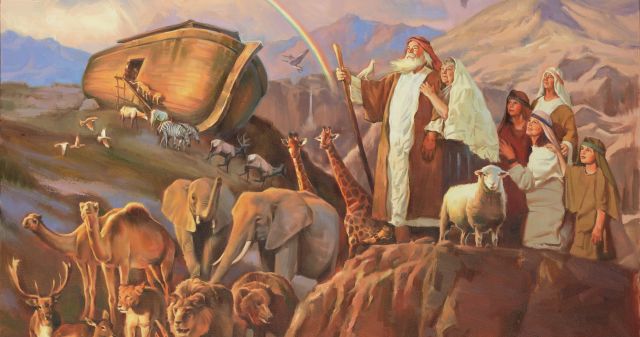
“Noah built an ark; and…the Lord smiled upon it.” (Moses 7:43)
Introduction
The great cataclysmic[1] flood wherein “Noah…prepared an ark to the saving of his house” is one of the most well known stories in the Judeo-Christian world. It is story that most of us can remember from our youngest days. If needed, anyone of us could offer a simple synopsis of what occurred: God came to the prophet Noah, warned him of the impending flood, commanded him to build an ark and gather unto temporal salvation all living things into it. Noah obeyed. The mighty windows of heaven were opened and the great deluge commenced to destroy all flesh save it be what had been safely gathered into the ark. As soon as the flood ceased and dry land reappeared, Noah offered sacrifice of thanks unto God and God reestablished his covenant with Noah and his seed offering the sign of the rainbow as a token that such destruction will never come again among the children of men.
But what is the purpose of this account? What doctrines or gospel principles does this scriptural account offer to us? What does any of this mean today, thousands of years after the fact? Our lesson today will look at each of these questions briefly, for it would be impossible to give an exhaustive treatment of any one of these questions. [Read more…] about Come, Follow Me Week 6 – Genesis 6–11; Moses 8
 John Gee is the William (Bill) Gay Research Professor in the Department of Asian and Near Eastern Languages at Brigham Young University. He has authored more than 150 publications on topics such as ancient scripture, Aramaic, archaeology, Coptic, Egyptian, history, linguistics, Luwian, rhetoric, Sumerian, textual criticism, and published in journals such as British Museum Studies in Ancient Egypt and Sudan, Bulletin of the Egyptological Seminar, Enchoria, Ensign, FARMS Review, Göttinger Miszellen, Issues in Religion and Psychotherapy, Journal of Academic Perspecitves, Journal of the American Research Center in Egypt, Journal of Book of Mormon Studies, Journal of Egyptian History, Journal of the Society for the Study of Egyptian Antiquities, Lingua Aegyptia, Review of Books on the Book of Mormon, Studien zur altägyptischen Kultur, and Interpreter, and by such presses as American University of Cairo Press, Archaeopress, Association Égyptologique Reine Élisabeth, E. J. Brill, Carsten Niebuhr Institute of Near Eastern Studies, Czech Institute of Egyptology, Deseret Book, de Gruyter, Harrassowitz, Institut Français d’Archéologie Orientale, Macmillan, Oxford University Press, Peeters, Praeger, Religious Studies Center, and Society of Biblical Literature. He has published three books and has edited eight books and an international multilingual peer-reviewed professional journal. He served twice as a section chair for the Society of Biblical Literature.
 Keith Erekson is an award-winning author, teacher, and public historian who has published on topics including politics, hoaxes, Abraham Lincoln, Elvis Presley, and Church history. He grew up in Baltimore, served a mission in Brazil, and earned advanced degrees in history and business. He works for the Church History Department in efforts to encourage outreach and historical engagement.
 Edwin E. Gantt is currently Professor of Psychology at Brigham Young University and a Research Fellow of the Wheatley Institution. He received his doctoral degree in Clinical Psychology from Duquesne University. He is the author of over 80 scholarly articles and book chapters. His primary research interests revolve around the questions of moral agency and the relationship between religion, science, and psychology. He is co-author (with Richard N. Williams) of Hijacking Science: Exploring the Nature and Consequences of Overreach in Psychology, editor of the textbook series Taking Sides: Clashing Views on Psychological Issues, and Co-Editor of the journal Issues in Religion and Psychotherapy (the official journal of the Association of Latter-day Saint Counselors and Psychologists). He teaches courses in the History and Philosophy of Psychology, Personality Theory, Qualitative Research Methods, Psychology of Religion, and (his favorite) LDS Perspectives on Psychology. He and his wife Anita live in Springville and have four wonderful sons, two amazing daughters-in-law, and two beautiful grandsons.